After the Headset Comes Off: The Lingering Mental Fog of Immersive Learning
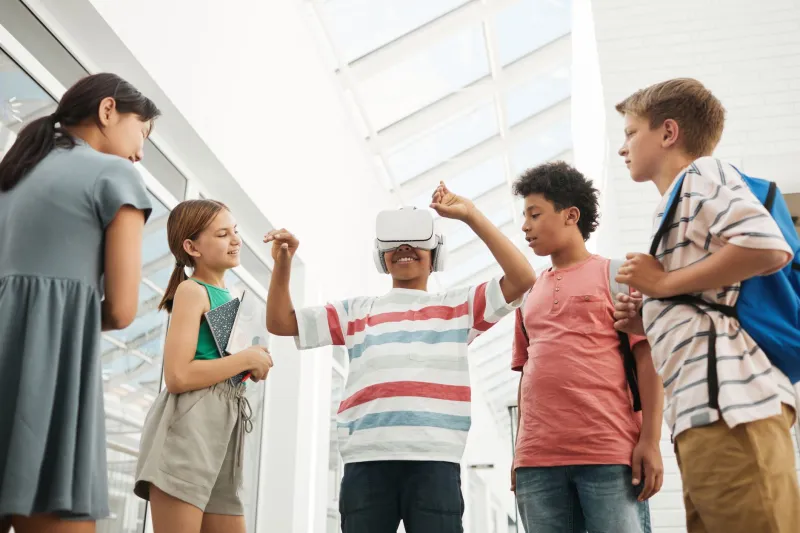
Marcus, a tenth grader in suburban Columbus, Ohio, came home from school one afternoon and reached for a door handle that wasn't there. He'd just finished a two-hour immersive history session inside his school's VR learning lab — a fully rendered walk through Revolutionary War-era Philadelphia — and his hand genuinely expected the latch to feel different. He laughed it off. His mom didn't find it quite as funny.
Stories like Marcus's are showing up more and more in teachers' lounge conversations, parent Facebook groups, and — increasingly — in early-stage neuroscience research. As schools across the US lean harder into metaverse-based learning, a quieter question is starting to get some long-overdue attention: what actually happens to a student's brain after they leave the virtual classroom?
The short answer? A lot. And not all of it is comfortable.
What Researchers Are Starting to Find
The term some researchers are using is "post-immersion cognitive residue" — essentially, the mental and emotional afterglow (or aftershock) that follows extended time in a highly immersive digital environment. It's not a formally diagnosed condition, but the pattern is consistent enough that neuroscientists studying extended reality (XR) are taking it seriously.
The brain, it turns out, doesn't flip a clean switch when you pull off a headset. During immersive VR sessions, your visual cortex, vestibular system, and proprioceptive networks are all working overtime to process an environment that looks and feels spatially real but physically isn't. When the session ends, those systems don't immediately recalibrate. There's a lag — sometimes minutes, sometimes hours — during which the brain is still partly oriented to the virtual space it just left.
Dr. Marjorie Chen, a cognitive neuroscientist at UC San Diego who studies immersive media, describes it this way: "The brain is remarkably adaptive, which is exactly why VR works so well for learning. But that adaptability cuts both ways. If you spend ninety minutes navigating a virtual environment, your neural maps have shifted. Re-anchoring to physical reality isn't instantaneous."
For educational settings — where students might transition directly from a VR session to a traditional classroom, a lunch period, or a school bus ride home — that re-anchoring gap is worth paying attention to.
What Teachers Are Actually Seeing
You don't need a neuroscience degree to notice the signs. Teachers who regularly facilitate metaverse learning sessions describe a recognizable cluster of post-session behaviors in their students: a kind of glassy, slightly unfocused look; unusual quietness; occasional clumsiness with physical objects; and what one middle school teacher in Austin, Texas, called "the thousand-yard stare of a kid who just came back from somewhere else."
Beyond the physical disorientation, educators are also reporting emotional residue. Students who've spent significant time inhabiting avatars — particularly in narrative-driven or socially immersive environments — sometimes carry the emotional weight of those experiences into their next class. A student who spent an hour as a Holocaust survivor in a historical empathy simulation might not be ready to pivot immediately to algebra. That's not a design flaw. It's arguably evidence that the experience worked. But it does create a transition challenge that most lesson plans don't account for.
"I had a girl come out of a climate change simulation absolutely gutted," said one seventh-grade science teacher in Portland, Oregon, who asked to remain anonymous. "She'd spent forty minutes watching her avatar's coastal hometown flood. She sat down for her next class and just stared at her desk. Her teacher thought she was being disrespectful. But she was still emotionally there."
The Identity Layer Nobody Talks About
There's another dimension to this that's even less discussed: avatar identity bleed. When students spend extended time as a customized avatar — especially one they've built to reflect or idealize some version of themselves — the psychological transition back to their physical identity can be subtly jarring.
For some students, particularly adolescents who are already navigating complex questions of self-image and social belonging, the virtual self can feel more confident, more capable, or simply more comfortable than the physical one. Logging off doesn't automatically dissolve that contrast. Some students report a low-level sense of deflation or disconnection after leaving immersive environments — not depression, but a kind of mild dissonance between who they were in the metaverse and who they feel like in the hallway.
This isn't a reason to pull the plug on avatar-based learning. The research on avatars and confidence — particularly for students who struggle socially or academically — is genuinely promising. But it does mean that thoughtful educators need to build in space for that psychological re-entry, not just assume it happens automatically.
Building Better Off-Ramps
So what can schools actually do? The good news is that some practical strategies are already emerging from educators who've been running immersive programs long enough to notice the patterns and adapt.
Build in transition time. This sounds almost too simple, but it matters enormously. A five-to-ten minute buffer between the end of a VR session and the next structured activity gives students' brains a chance to begin re-orienting. Some teachers use this window for light physical movement — walking around the room, stretching, handling physical objects — which helps re-engage proprioceptive systems and signal to the brain that the body is back in real space.
Use grounding prompts. A brief verbal or written reflection immediately after a session — "What's one thing you can see, hear, or touch right now?" — can help anchor students in their physical environment. It sounds like mindfulness, because it basically is, and there's solid cognitive science behind why it helps.
Don't schedule back-to-back immersion. If a student has a VR session in first period, the second period teacher deserves a heads-up. And stacking multiple immersive sessions in a single school day without adequate recovery time is a recipe for compounding the disorientation effect.
Talk about it openly. Students who understand why they feel a little foggy after a VR session are better equipped to manage it than students who just feel weird and don't know why. Normalizing the experience — framing it as a natural side effect of powerful learning technology — removes the stigma and gives students agency.
The Bigger Picture
None of this is an argument against immersive learning. The educational potential of metaverse environments is real, and the experiences they make possible — walking through ancient Rome, conducting virtual chemistry experiments, practicing a job interview in a consequence-free space — are genuinely transformative in ways that worksheets and textbooks simply can't replicate.
But transformative experiences have weight. They leave marks. And part of designing responsible, effective virtual learning environments means taking seriously what happens not just during the session, but in the quieter moments after the headset comes off and a student walks back into the physical world, still half-somewhere else.
The metaverse is a powerful place to learn. The hallway outside the VR lab is where that learning has to land. Making sure students can make that journey — fully, cleanly, and without losing themselves in the transition — is one of the most important design challenges in digital education right now.
And it starts with teachers paying attention to the kid who reaches for a door handle that isn't there.