Acing the Quest, Failing the Test: The Troubling Gap Between Metaverse Mastery and Standardized Scores
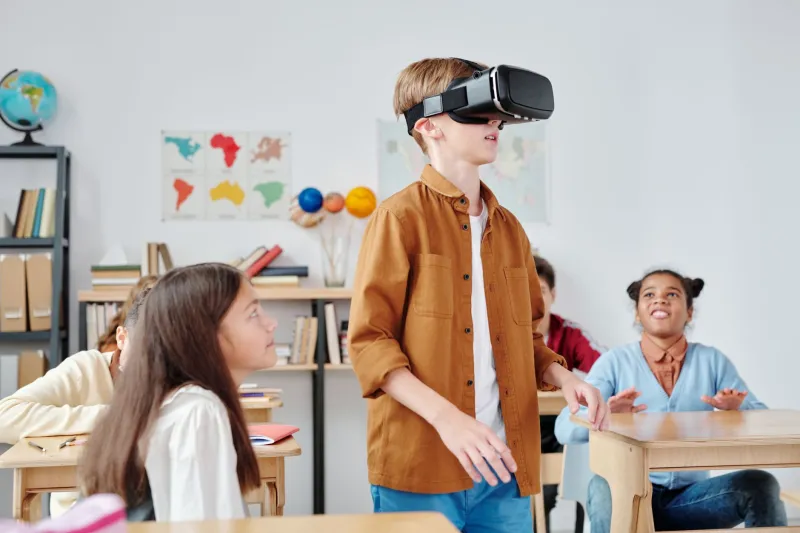
Picture this: A seventh grader navigates a fully immersive virtual ecosystem, correctly identifies the impact of deforestation on local water cycles, and leads her team to a successful conservation outcome — all inside a metaverse science module. Two weeks later, she stares at a multiple-choice question covering the exact same concept and draws a complete blank.
Her teacher is baffled. Her parents are frustrated. And she's just... defeated.
This isn't a rare glitch in the system. Educators across the country are reporting a pattern that's becoming impossible to ignore: students who clearly get it inside virtual learning environments are consistently underperforming when assessment time rolls around in the traditional sense. It's one of the most confusing paradoxes in modern education, and it's worth pulling apart carefully.
The Brain Learns Differently in Immersive Spaces
Here's the thing about metaverse learning — it's genuinely good at what it does. Immersive, experiential environments engage multiple cognitive pathways simultaneously. When a student does something in VR rather than reads about it, the brain encodes that experience with richer contextual detail. Researchers call this "embodied cognition," and it's a real phenomenon: physical and spatial engagement deepens memory formation.
But here's where the paradox kicks in. That deeply contextual memory? It's heavily tied to the environment where it was formed. Psychologists have studied this for decades under the term "context-dependent memory" — the idea that what you learned in one setting is most easily retrieved in that same setting. Pull a student out of the virtual world and drop them into a fluorescent-lit gymnasium with a No. 2 pencil, and the retrieval cues that helped them ace the quest are suddenly... gone.
The knowledge didn't disappear. But the brain's filing system wasn't built for the format of the test.
Standardized Tests Were Designed for a Different Kind of Learning
Let's be honest: standardized assessments were never designed with immersive digital environments in mind. They measure a specific kind of knowledge retrieval — isolated, decontextualized, and timed. That format works reasonably well when students have spent weeks reading textbooks and filling out worksheets, because those activities prime the brain for exactly that style of recall.
Metaverse learning does the opposite. It builds understanding through exploration, trial and error, collaboration, and real-time feedback. Students develop what educators sometimes call "procedural knowledge" — knowing how to do something — rather than the "declarative knowledge" that standardized tests tend to reward, which is knowing that something is true.
Neither type of knowledge is more valuable in the long run. But only one of them shows up on the score report that follows a kid through their academic career.
The Confidence Collapse Is Real — and It Has Consequences
There's an emotional dimension to this problem that doesn't get talked about enough. Students who thrive in metaverse classrooms often develop genuine confidence in their abilities. They take risks, lead groups, iterate on failures, and build a real sense of competence. Then a poor test score lands, and all of that self-assurance takes a hit.
For some students — particularly those who already struggle in traditional academic settings but bloom in virtual environments — this whiplash is especially damaging. They've finally found a space where they feel capable, and then the system tells them they're not. That's a tough message to bounce back from.
Teachers working in districts that have rolled out VR and metaverse platforms are increasingly raising this concern. The technology is doing its job. The assessment infrastructure just hasn't caught up.
What Educators Can Actually Do Right Now
The good news is that this gap isn't inevitable. There are practical strategies educators can start implementing without waiting for a policy overhaul.
Bridge the formats deliberately. After a metaverse learning module, build in low-stakes practice that mimics traditional test conditions. Have students answer written questions about what they just experienced in the virtual space. This helps the brain start building connections between the immersive memory and the decontextualized format.
Use retrieval practice across contexts. Spacing out recall exercises — some in the virtual environment, some on paper, some verbal — helps students build more flexible memory networks. The goal is to make the knowledge accessible regardless of the setting.
Teach students about the gap itself. This one sounds simple, but it's powerful. When students understand why they might struggle to translate VR learning to a written test, they can approach that challenge more strategically. Metacognition — thinking about how you think — is a skill that pays dividends across every subject.
Advocate for blended assessment models. Some forward-thinking districts are already experimenting with portfolio-based assessments, performance tasks, and project demonstrations alongside traditional tests. If your school hasn't had this conversation yet, the metaverse classroom paradox is a compelling reason to start it.
Don't abandon immersive learning — supplement it. The answer isn't to scale back metaverse education because it doesn't align neatly with standardized testing. The answer is to build scaffolding that honors both the depth of virtual learning and the reality of how students are currently being evaluated.
The Bigger Question Nobody Wants to Ask
There's a harder conversation lurking underneath all of this, and it's one that the education system is going to have to have eventually: Are we measuring the right things?
If a student can successfully apply knowledge in a complex, dynamic, real-world-adjacent environment — which is essentially what a well-designed metaverse module creates — but can't recall isolated facts under timed conditions, what does that actually tell us about their learning? And whose problem is that, really?
Metaverse platforms are, in many ways, holding up a mirror to the limitations of traditional assessment. That's uncomfortable. It's also kind of the point.
The students aren't broken. The mismatch is. And figuring out how to close that gap — without abandoning either the promise of immersive education or the practical realities of how schools function today — is one of the most important design challenges facing educators right now.
The quest isn't over. It's just moved to a different level.