Your Brain Thinks Your Avatar Is You — And That Changes Everything About How Students Learn
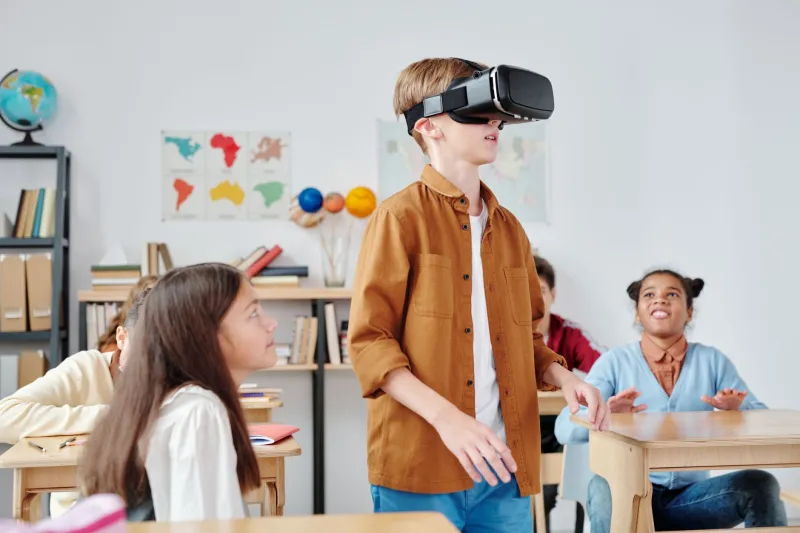
Here's something that sounds a little wild: when a student reaches out their hand in a VR environment and picks up a virtual object, parts of their brain light up in ways that look a whole lot like actually picking something up for real. Not exactly the same — but close enough that neuroscientists are paying serious attention. And educators designing metaverse curricula probably should be too.
The science here isn't brand new, but it's finally catching up with the technology. As virtual learning environments become more sophisticated — and more common in American classrooms — researchers are digging into a fascinating question: does moving through a virtual world change the way the brain encodes information? Spoiler: it looks like it does.
What "Embodied Cognition" Actually Means (And Why It Matters for the Metaverse)
Embodied cognition is a branch of cognitive science built on a pretty straightforward idea — that thinking isn't just something your brain does in isolation. Your body is part of the process. The way you move, gesture, and physically interact with the world shapes how you form concepts, store memories, and make sense of abstract ideas.
You've probably seen this play out in a regular classroom. Students who use their hands while explaining a math problem often demonstrate deeper understanding than those who sit still. Kids who act out a scene from a novel tend to remember it longer than those who just read it silently. That's embodied cognition at work.
Now take that principle and drop it into a virtual learning environment. A student in a VR history lesson isn't just watching a video about ancient Rome — they're walking through a reconstructed forum, crouching to examine an artifact, gesturing to point out architectural details. Their body is involved, even if "their body" is technically an avatar wearing a headset in a classroom in Ohio.
The Mirror Neuron Connection
One reason this matters so much comes down to mirror neurons — a class of brain cells that fire both when you perform an action and when you observe someone else doing it. They're a big part of why humans learn so effectively through imitation and observation. And they respond differently to embodied experience versus passive video.
Research comparing VR-based instruction to traditional video lessons has found measurable differences in how actively the brain's motor and sensory systems engage. When learners feel like they're in the scene — when their avatar moves and the environment responds — mirror neuron activity tends to be more robust. The brain isn't just cataloging information; it's rehearsing it in a quasi-physical way.
For educators, this distinction is significant. A student watching a YouTube video about the water cycle is processing information. A student whose avatar physically moves water molecules through a virtual ecosystem simulation is doing something neurologically different — something that may lead to stronger retention and more flexible application of the concept.
Spatial Memory: The Metaverse's Secret Weapon
Humans are remarkably good at remembering where things are. Evolutionary biologists will tell you this makes sense — our ancestors needed to navigate complex physical environments to survive. The brain has dedicated systems for spatial memory that are deeply tied to learning and recall.
Here's where virtual environments get interesting. When students navigate a 3D metaverse classroom or virtual lab, they're activating those same spatial memory systems. The brain starts associating learned content with virtual locations — a phenomenon sometimes called the "method of loci," or memory palace technique, that's been used by memory champions for centuries.
A student who learned about DNA replication by physically walking through a giant virtual cell — moving past the nucleus, watching the helicase unzip the double helix right in front of them — has spatial anchors for that information that a student who watched a flat animation simply doesn't. When test time comes, the brain has more retrieval pathways to work with.
Some early studies on VR-based STEM education at the university level have reported retention improvements of 20 to 30 percent compared to traditional instruction, though researchers are careful to note that curriculum design plays a huge role in whether those gains materialize.
Gesture-Based Learning: It's Not Just Hand-Waving
Another piece of the puzzle is gesture. Decades of research on gesture-based learning — pioneered by psychologists like Susan Goldin-Meadow at the University of Chicago — has shown that when learners gesture while thinking through a problem, they often arrive at solutions faster and remember them longer.
In a metaverse classroom, gesture becomes a core part of the interface. Students aren't clicking a mouse — they're reaching, pointing, building, manipulating. That physical expressiveness, even in simulated form, appears to support the kind of deep processing that leads to durable learning.
For curriculum designers, this is an actionable insight. Build in moments where students have to do something physical — assemble a virtual model, trace a route on a 3D map, physically sort and categorize objects. Don't just replicate a textbook in 3D. Design for the body, not just the screen.
What This Means for Teachers Building Metaverse Lessons
So what does all of this mean practically? A few things worth keeping in mind:
Motion should be meaningful, not decorative. Just because students can move around in a virtual environment doesn't mean the movement is automatically doing cognitive work. Design activities where the physical interaction is tied directly to the learning objective. Moving a virtual lever to demonstrate mechanical advantage teaches more than clicking a button that does the same thing.
Give students agency over their bodies in the space. Research on embodied learning consistently finds that self-directed movement produces stronger outcomes than scripted walkthroughs. Let students explore, backtrack, and approach problems from different angles — literally.
Pair virtual embodiment with verbal reflection. The learning gains from embodied experiences tend to consolidate more effectively when students are asked to articulate what they did and why. A quick post-activity debrief — even in a chat box — can significantly boost retention.
Don't overlook students without full VR access. Not every district has headsets for every student. The good news is that some of these embodied learning principles apply even to desktop-based 3D environments, where students use keyboard or controller input to navigate and interact. It's not the same as full immersion, but it's not nothing, either.
The Bottom Line
The metaverse isn't just a flashier way to deliver the same old content. At its best, it's a fundamentally different kind of learning environment — one that engages the brain through the body in ways that passive digital media simply can't. The neuroscience is still catching up with the technology, and there's a lot we don't yet know. But what's emerging is genuinely exciting: when students inhabit a virtual world, their brains treat it as more real than we might expect. And that reality — however simulated — may be one of the most powerful educational tools we've ever had.