Future-Proof Your Students: 5 Must-Have Skills for the Metaverse Workplace (Teachers Are Already On It)
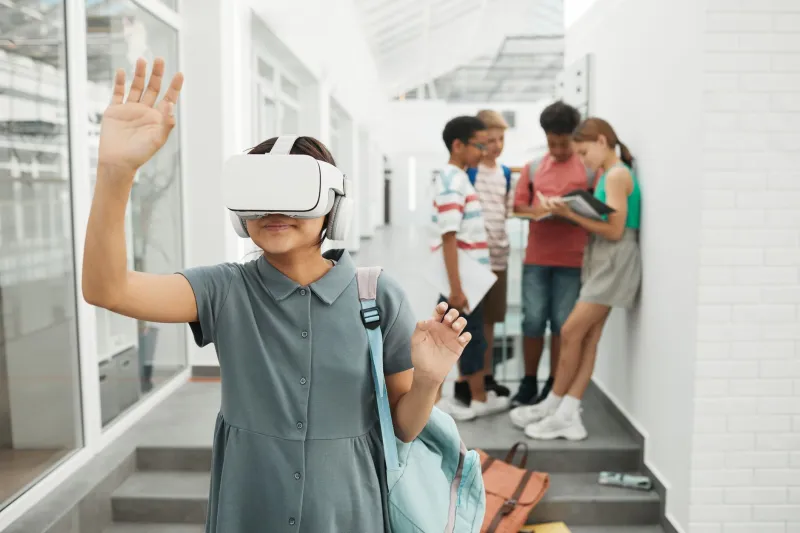
Here's a thought experiment: ask a room full of high schoolers what a typical workday looks like for a civil engineer, a surgeon, or a retail merchandiser in 2030. Odds are, the answers won't include virtual design reviews conducted in shared 3D environments, remote surgical training in photorealistic simulations, or product placement tested in virtual store replicas before a single shelf gets stocked.
But that's exactly where industries are heading. Companies like Walmart, Boeing, Ford, and Accenture have already invested heavily in metaverse-based training and collaboration tools. The question isn't whether the workplace will change — it's whether the students walking across graduation stages in the next five years will be ready for it.
Spoiler: a growing number of educators are making sure they will be. Here are the five skills that keep coming up in conversations with teachers, tech industry leaders, and workforce development specialists — and the creative ways schools are actually teaching them.
1. Spatial Computing Literacy
What it is: The ability to understand, navigate, and create within three-dimensional digital environments. Think of it as the next evolution of screen literacy — instead of working with flat interfaces, workers increasingly interact with spatial data, 3D models, and layered augmented overlays.
Why employers want it: Architecture firms are reviewing building designs in VR walkthroughs. Manufacturing companies are training assembly workers using AR overlays on real equipment. Healthcare systems are using spatial simulations for everything from anatomy education to surgical planning. A worker who can't orient themselves in these environments — or worse, finds them disorienting and unusable — is increasingly at a disadvantage.
How schools are teaching it: Districts in states like Georgia and Arizona have introduced spatial computing units inside existing STEM courses, using tools like CoSpaces Edu and Microsoft Mesh to have students build and present 3D projects. One middle school teacher in Phoenix described having her students design virtual science fair displays in a shared metaverse space rather than on poster boards. "They learn the content AND they learn how to think spatially," she said. "Those two things used to be separate. Now they're the same lesson."
2. Virtual Collaboration and Digital Team Dynamics
What it is: The capacity to work effectively with teammates you may never meet face-to-face, inside shared digital environments where communication cues, workflows, and social norms operate differently than in a physical office.
Why employers want it: Remote and hybrid work aren't going anywhere, and metaverse-based collaboration tools are making distributed teams more sophisticated — and more demanding. Managing a shared project inside a virtual workspace, reading tone through avatar behavior, dividing responsibilities across time zones — these are real skills that take practice.
How schools are teaching it: Project-based learning has always valued teamwork, but some schools are deliberately moving group work into virtual environments to build these muscles early. A high school in suburban Chicago partnered with a school in rural Tennessee for a joint history project conducted entirely inside a virtual environment — students from both schools built a shared digital exhibit, negotiating decisions asynchronously and in real-time virtual meetings. Teachers on both ends noted that students developed not just collaboration skills, but a more sophisticated awareness of communication across distance and difference.
3. Digital Citizenship in Immersive Spaces
What it is: Understanding rights, responsibilities, ethics, and safety in virtual environments — including identity, consent, privacy, intellectual property, and the social dynamics unique to immersive digital spaces.
Why employers want it: Companies running internal metaverse platforms are already encountering issues around avatar harassment, data privacy, and the blurry line between personal and professional digital identity. Employees who arrive with a thoughtful framework for navigating these questions are genuinely valuable.
How schools are teaching it: Digital citizenship education has been around for years, but forward-thinking programs are updating it specifically for immersive contexts. Common Sense Media has expanded its curriculum to address metaverse-specific scenarios. Some schools are running structured simulations — presenting students with realistic ethical dilemmas inside virtual environments and facilitating discussions about how to respond. "It's one thing to talk about online ethics in the abstract," noted one high school counselor in Oregon. "It hits differently when a student is actually inside a virtual space and has to make a real-time decision."
4. Adaptive Technology Fluency
What it is: Not mastery of any single platform, but the ability to learn new digital tools quickly, transfer skills across environments, and troubleshoot independently when technology behaves unexpectedly.
Why employers want it: The metaverse ecosystem is fragmented and evolving fast. No employer expects a new hire to already know their specific internal platform — but they absolutely need people who can get up to speed in days, not months, and who don't freeze when software glitches or interfaces change.
How schools are teaching it: Some educators are deliberately rotating the tools they use throughout the year — not sticking with one platform but cycling through several so students build meta-skills around learning new interfaces. A computer science teacher in Austin described it this way: "I don't care if they master any one tool. I want them to become fast learners. So we switch things up constantly. They get frustrated at first, and then they get really good at figuring things out."
Game-based learning environments, which ask students to solve problems in novel virtual contexts, are also building this adaptability in more organic ways.
5. Data Literacy in Spatial and Experiential Contexts
What it is: The ability to interpret, question, and make decisions based on data generated by immersive environments — including user behavior data, simulation outputs, and the metrics that metaverse platforms produce in abundance.
Why employers want it: Metaverse platforms generate enormous amounts of behavioral data. Marketing teams analyze how customers move through virtual stores. Training managers review engagement metrics from VR onboarding simulations. Designers iterate based on how users interact with virtual spaces. Employees who can read and reason about this data are significantly more useful than those who can't.
How schools are teaching it: Data literacy has gotten a boost from the broader push toward computational thinking in K-12 education, but some schools are connecting it explicitly to metaverse contexts. Students in one New Jersey district recently analyzed engagement data from their school's virtual open house — reviewing which virtual rooms got the most traffic, how long visitors stayed, and what that suggested about communication design. It was data literacy with a genuinely relevant application.
The Bigger Picture
What's striking about this list isn't any single skill — it's the way they interconnect. A student who develops spatial fluency, collaborative instincts, ethical grounding, adaptive learning habits, and data reasoning isn't just ready for a metaverse workplace. They're ready for whatever comes after that, too.
The educators doing this work aren't waiting for a standardized curriculum to arrive from the top down. They're experimenting, iterating, and sharing what works with each other. That grassroots energy — teachers solving real problems with real students — is exactly the kind of innovation that tends to outlast any particular technology trend.
The metaverse will keep evolving. The skills it demands, though, are starting to look a lot like the skills we've always wanted students to have — just expressed in a new dimension.