Thriving Online, Struggling Offline: The Hidden Social Cost of Metaverse Learning
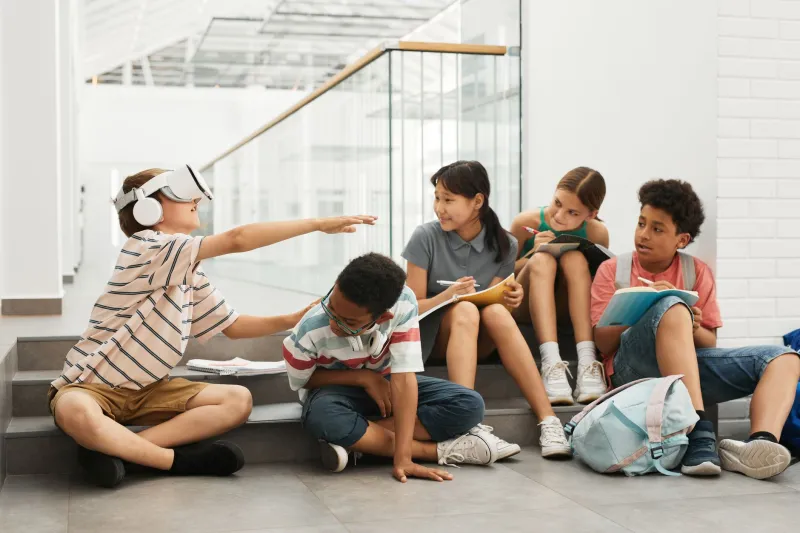
Picture a seventh grader in suburban Ohio who leads her virtual study group with confidence, holds the room during metaverse debates, and collaborates across time zones with classmates she's never physically met. Now picture her at the lunch table, eyes down, shoulders tense, struggling to make small talk with someone standing three feet away.
This isn't a rare story anymore. Teachers across the country are noticing it. Counselors are flagging it. And researchers are starting to put hard data behind what many educators already suspected: time spent thriving in virtual learning environments doesn't automatically translate into comfort in the physical world.
So what's actually going on here — and what can schools do about it?
The Digital Confidence Trap
Virtual classrooms in the metaverse offer something traditional schools often can't: a layer of distance that feels safe. Students can think before they type. They can craft their avatars. They can mute themselves when anxiety spikes. For a lot of kids — especially those who've historically felt overlooked or anxious in conventional settings — that breathing room is genuinely transformative.
But that same buffer can become a crutch.
Dr. Linda Charness, a developmental psychologist at the University of Michigan who studies digital environments and adolescent behavior, describes it this way: "The brain learns what it practices. If a student spends hundreds of hours communicating through a screen — with built-in delays, visual filters, and text-based fallbacks — it gets very good at that mode. What it doesn't get is repetitions of the messier, faster, uncontrollable nature of in-person interaction."
In other words, it's not that virtual learning is bad for social development. It's that it's training a specific kind of social skill — and that skill set has some real gaps when students step outside the headset.
What Teachers Are Actually Seeing
Spend five minutes in a teachers' lounge at a school that's been running a metaverse curriculum for a year or more, and you'll hear some version of the same observation.
"My most engaged virtual students are sometimes my most withdrawn in person," says Marcus Webb, a high school English teacher in Portland, Oregon, who's been integrating VR-based learning into his classroom for two years. "They're brilliant in the metaverse. They write, they discuss, they collaborate. But when I ask them to do a face-to-face presentation, something just... shuts down."
What Webb and teachers like him are describing isn't social anxiety in the clinical sense — though that's sometimes a factor too. It's more like a mismatch in social fluency. Students who've become highly skilled at avatar-mediated communication are encountering the physical world's demands — eye contact, reading micro-expressions, managing the timing of interruptions — and finding those skills underdeveloped.
Elementary school counselors are seeing it show up even earlier. Kids who spend significant learning time in immersive virtual environments sometimes struggle with basics like waiting their turn in a physical conversation or picking up on a classmate's discomfort during play.
The Neuroscience Behind the Gap
Here's where things get genuinely interesting — and a little sobering.
Research out of Stanford's Virtual Human Interaction Lab has long explored how VR shapes empathy and behavior. More recent work is beginning to examine the flip side: what happens to in-person social processing when virtual interaction becomes dominant.
The short version? The brain regions involved in reading physical social cues — the superior temporal sulcus, the fusiform face area — need regular, real-world input to stay sharp. They're not atrophying in kids who use VR heavily, but they may not be getting the consistent activation they need to develop as robustly as they would in a more balanced environment.
At the same time, the prefrontal cortex — which governs impulse control and social decision-making — is still under heavy construction in adolescents. If the primary social inputs during those developmental years are filtered through a virtual interface, some researchers worry we may be setting up a generation that's highly fluent in one social dialect but less practiced in another.
None of this is a reason to pull the plug on metaverse education. But it is a reason to pay attention.
Bridging the Gap: What Educators Are Testing
The good news is that schools aren't just sitting with this problem — they're actively experimenting with solutions. And some of those experiments are showing real promise.
Blended social design. Some schools are deliberately structuring metaverse learning so that virtual collaboration leads into in-person debrief sessions. Students might spend a week working on a project in a shared virtual environment, then present their findings face-to-face to a live audience. The idea is to use the confidence built in the virtual space as a launching pad for physical-world interaction, not a replacement for it.
Explicit social skill instruction. A handful of districts — including a pilot program in the Denver metro area — are pairing VR curriculum with what they're calling "analog social labs": structured, low-stakes activities specifically designed to practice the skills that virtual environments don't build. Things like reading body language, managing physical group dynamics, and practicing eye contact in a supportive setting.
Educator awareness training. Some professional development programs are now including modules that help teachers recognize the signs of virtual-physical social mismatch early, so they can intervene before patterns become entrenched. This isn't about penalizing students for their virtual fluency — it's about making sure no one falls through the cracks.
Avatar-to-person transition protocols. A few forward-thinking platforms are building in features that gently scaffold the transition from virtual to physical interaction — things like video face reveals at the end of collaborative projects, or hybrid meeting modes that mix avatar and live-camera participation.
The Bigger Picture
It's worth stepping back for a second and being honest about what we don't know yet. Metaverse education at scale is still relatively new. The longitudinal data on how sustained virtual learning affects social development over years — not months — is still being gathered. We're making a lot of decisions based on early signals and educated guesses.
What we do know is that the students showing up in these virtual classrooms are real kids with real futures. They'll need to negotiate job interviews, navigate friendships, manage conflict, and build relationships in physical spaces for the rest of their lives — even as those lives become increasingly digital.
The goal was never to prepare students only for the metaverse. It was to prepare them for everything.
That means the most important design question in virtual education right now might not be "how do we make the virtual experience better?" It might be "how do we make sure the virtual experience makes students better — in every world they'll ever inhabit?"
That's a harder question. But it's the right one.