Zoned In or Zoned Out? How Metaverse Classrooms Are Rewiring the Way Students Pay Attention
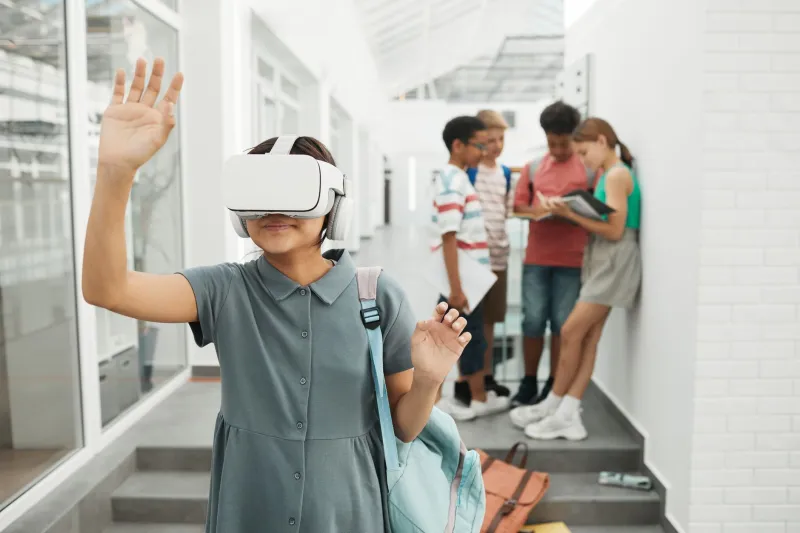
There's a moment most VR educators know well. A student slips on a headset, steps into a virtual environment, and goes completely still. Not bored-still. Locked-in still. For a few seconds, the outside world simply doesn't exist.
Then, about twelve minutes later, that same student is spinning their avatar in circles, poking at decorative objects in the corner of the virtual room, and has completely lost the thread of the lesson.
So which is it? Is the metaverse a focus supercharger or a distraction machine? The honest answer is both — and understanding why might be the most important thing an educator can do right now.
Why Immersive Environments Hit Different Than a Laptop Screen
Here's the thing about traditional screens: your brain knows they're fake. You're sitting in a chair, feeling the cushion beneath you, hearing your roommate's TV through the wall. A portion of your cognitive bandwidth is always managing the real world around you.
In a well-designed VR environment, that changes. Researchers call this presence — the psychological sense that you're actually somewhere. And presence, it turns out, has a direct relationship with attention. When your brain believes it's in a place, it allocates attentional resources the way it would in that physical space.
Studies out of institutions like the University of Maryland have shown that people recall information learned in VR significantly better than information learned on flat screens — not because VR is prettier, but because spatial memory is one of the oldest and most powerful cognitive systems humans have. Your brain is built to remember where things happened.
This is what educators mean when they talk about embodied learning — the idea that knowledge sticks when your body is part of the experience. When a student doesn't just read about the water cycle but physically walks through a simulated cloud formation, different neural pathways engage. Attention isn't just captured; it's anchored.
The Gamification Trap
But here's where it gets complicated. Most metaverse learning platforms don't just offer spatial immersion — they layer in gamification: points, badges, unlockable environments, avatar customization rewards. And while these elements can absolutely spike engagement, they can also quietly train students to chase stimulation rather than sustain focus.
Think about how dopamine works. Short reward loops — the kind that games are specifically engineered to deliver — condition the brain to expect frequent payoffs. When a lesson doesn't deliver that hit every few minutes, attention drifts. Students aren't being lazy. Their brains have been calibrated to a rhythm that a 30-minute lecture on the American Revolution simply cannot match.
This is the gamification trap: using game mechanics to get students into a virtual classroom, then watching those same mechanics make it harder for them to stay in one.
Dr. Patti Valkenburg at the University of Amsterdam has spent years studying how digital media reshapes attentional patterns in young people. Her work suggests that fragmented, high-stimulation environments can reduce tolerance for slower, deeper cognitive tasks over time. The metaverse, designed carelessly, could accelerate that trend dramatically.
What the Research Actually Recommends
So how do educators thread this needle? The good news is that the same immersive qualities that create distraction risks can be redirected to build genuine concentration — if the lesson design is intentional.
Start with a grounding ritual. Before diving into content, give students 60 to 90 seconds of structured observation in the virtual environment. Ask them to identify three specific details about their surroundings and share one with the group. This activates spatial attention deliberately rather than letting curiosity scatter it.
Design for depth over novelty. Rotating through five different virtual environments in a single class period feels exciting, but it trains students to expect constant change. Pick one rich environment and build the entire lesson within it. Let students discover new layers of that space as the lesson progresses. Depth, not variety, is what builds sustained focus.
Use embodied tasks at key attention inflection points. Research consistently shows that attention naturally dips around the 10-to-12-minute mark. Instead of pushing through with more content, build in a short embodied task — have students physically move to a different part of the virtual environment, manipulate an object, or collaborate on a spatial puzzle. This resets the attentional clock without fragmenting the learning arc.
Separate rewards from learning milestones. If you're using gamification, be strategic about when rewards appear. Tying badges to task completion rather than time-on-task or clicks trains students to associate focus with payoff — which is exactly the habit you want to build.
The Deeper Question Nobody's Asking
Here's something worth sitting with: attention isn't just a classroom skill. It's increasingly a life skill that many researchers argue is in genuine crisis across American culture. Surgeon General advisories, congressional hearings on social media, a national conversation about phone bans in schools — all of it points to the same underlying anxiety. We are worried about what screens are doing to our kids' minds.
The metaverse arrives into that conversation as either a villain or a hero, depending entirely on how it's used. An immersive environment designed with attention science in mind could actually be one of the most powerful tools educators have ever had for rebuilding concentration in students who've grown up fragmented by feeds and notifications. The spatial memory advantage is real. The embodied learning benefit is real.
But an immersive environment designed purely for engagement metrics — built to hook eyeballs and maximize time-on-platform — could do serious damage.
The difference isn't the technology. It's the intention behind the lesson design.
Building Classrooms That Build Focus
If you're an educator heading into a metaverse environment this semester, here's the simplest reframe: stop asking how do I keep students engaged? and start asking how do I help students practice sustaining attention?
Engagement is a feeling. Attention is a skill. The metaverse, at its best, is a training ground for that skill — a place where the brain gets to practice being fully somewhere, following a thread of thought through space, and discovering that staying focused is actually more satisfying than being constantly stimulated.
That's not a utopian vision. It's a design challenge. And it's one that educators, not algorithms, are best positioned to meet.