Your Students' Brains Are Overwhelmed in VR — Here's What You Can Do About It
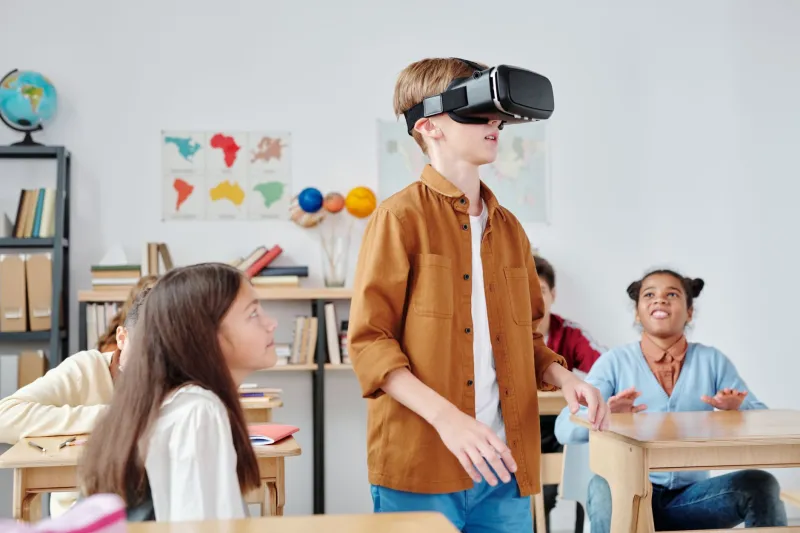
Picture this: you've spent two hours designing a gorgeous virtual field trip through ancient Rome. Students strap on headsets, load into the environment, and within four minutes, half the class is comparing avatar hairstyles in a corner of the forum. Sound familiar? If you're teaching in a metaverse environment, you probably don't need to imagine it — you've lived it.
Distraction in virtual classrooms isn't just a discipline problem. It's a design problem, a neuroscience problem, and honestly, a little bit of a human nature problem. And figuring out how to work with it — rather than constantly fighting against it — might be the most important skill an educator can develop right now.
Why VR Is Basically a Distraction Machine (By Design)
Here's the uncomfortable truth: the same features that make metaverse platforms so engaging are the exact features that pull students off task. Avatar customization, environmental interactivity, spatial audio from multiple directions, other students moving around in your peripheral vision — all of it competes for cognitive bandwidth simultaneously.
Dr. Peter Hancock, a human factors researcher at the University of Central Florida, has studied how immersive environments tax working memory in ways that flat-screen digital learning simply doesn't. In VR, the brain is processing spatial information, social cues, auditory input, and instructional content all at once. That's a heavy cognitive load, and for younger students especially, the prefrontal cortex — the part of the brain responsible for filtering irrelevant stimuli — just isn't equipped to handle it efficiently.
This is fundamentally different from the kind of distraction you see in a traditional Zoom class, where a student might drift to a second browser tab. In the metaverse, the distraction is the learning environment. You can't just close the tab.
What Educators Are Actually Dealing With
We talked to several teachers who are actively using platforms like Engage, Spatial, and Minecraft Education Edition in their classrooms. The challenges they described were remarkably consistent.
"The first ten minutes are basically a wash," said one middle school science teacher in Austin, Texas. "Kids are spinning around, poking at things, trying to figure out what their voice sounds like in the space. I've had to completely restructure my lesson timing to account for that."
A high school history teacher in suburban Chicago described a different problem: social clustering. "Students gravitate toward their friends in the virtual space the same way they do in a physical hallway. The spatial element makes it feel more like a social environment than a classroom, and that's a mental shift kids don't automatically make."
Both teachers noted that the issue wasn't student misbehavior in the traditional sense — it was that the platform itself invited exploration and social interaction. The environment was doing exactly what it was built to do. The lesson plan just hadn't caught up.
The Cognitive Overload Trap
Neuroscientists use the term "cognitive overload" to describe what happens when the brain receives more information than it can process at one time. In metaverse learning, this can manifest in some unexpected ways: students who seem disengaged might actually be overwhelmed, not bored. They've hit a processing ceiling and defaulted to the easiest available stimulus — which, in a richly interactive virtual world, is almost always something off-task.
Research published in the journal Computers & Education found that high-fidelity VR environments, while motivating, can actually suppress learning outcomes when instructional design doesn't account for environmental complexity. In other words, a more visually stunning virtual classroom isn't automatically a more effective one.
The takeaway isn't that we should strip metaverse classrooms down to blank white rooms. It's that the design of the learning experience needs to be as intentional as the design of the environment itself.
Practical Strategies That Actually Work
So what can educators do? The good news is that the same interactivity causing the distraction can be harnessed to solve it — if you approach lesson design strategically.
Front-load the exploration. Give students five to ten minutes of unstructured time at the start of a session to get the novelty out of their system. Set explicit expectations: "You have eight minutes to explore. When the timer ends, we meet at the amphitheater." Trying to suppress curiosity in an immersive environment is a losing battle. Working with it is much more effective.
Use spatial anchoring. Designate specific locations in the virtual environment for specific types of activity — a discussion zone, a quiet work area, a collaborative building space. Physical location in VR creates cognitive context cues that help students mentally shift gears, much like how being in a library primes people for quiet focus.
Chunk your content aggressively. Shorter instructional segments with clear transitions work better in VR than extended lectures. Aim for five to seven minute instructional bursts followed by an interactive task. This rhythm matches how attention actually functions in high-stimulation environments.
Leverage the medium's strengths for focus, not just fun. Gamified objectives — "find three artifacts hidden in this environment before we regroup" — direct attention purposefully. When exploration has a goal attached to it, it stops being a distraction and starts being the lesson.
Establish virtual classroom norms early. Just as physical classrooms have rules about where to sit and when to talk, metaverse classrooms need explicit behavioral norms for avatar interaction, movement, and communication. These work best when students help create them.
The Bigger Picture
Distraction in virtual classrooms isn't a sign that the technology doesn't work. It's a sign that we're still learning how to use it well — and that's actually kind of exciting. Every new educational medium has gone through this phase. Television was going to revolutionize learning until educators realized passive viewing wasn't enough. The internet was chaotic in classrooms until digital literacy frameworks caught up.
The metaverse is no different. The neuroscience is catching up, the pedagogical frameworks are being built in real time, and educators on the front lines are developing the practical wisdom that will eventually become best practice.
Your students' brains aren't broken. They're just being asked to do something genuinely new. The more intentionally you design for that reality, the more the virtual environment stops working against your lesson — and starts working with it.