Skip the Permission Slips: 10 Virtual Field Trips That Will Blow Your Students' Minds Right Now
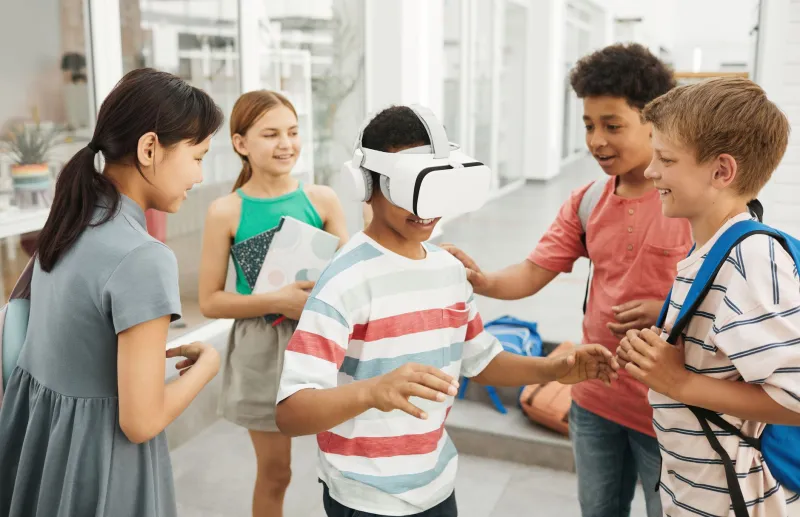
Field trips used to mean weeks of planning, a stack of permission slips, a school bus that smelled like old gym shoes, and a hard budget cap that ruled out anything too far from your zip code. For a lot of schools — especially those in rural areas or districts with tight budgets — truly transformative field trips were simply out of reach.
That's changing fast. Metaverse platforms and immersive VR tools are putting experiences once reserved for well-funded suburban schools within reach of any classroom with a decent internet connection. We've rounded up 10 virtual destinations that educators can actually use right now — with notes on what subject areas they serve best, what platforms host them, and what they'll cost your school.
1. Walk Through Ancient Rome — Google Arts & Culture + Rome Reborn
Best for: World history, social studies, Latin, art history
Cost: Free
Google Arts & Culture has partnered with archaeologists and historians to offer detailed virtual walkthroughs of ancient Roman sites. Pair that with Rome Reborn, a research project that digitally reconstructs the city as it looked in 320 AD, and you've got a history lesson that no textbook can compete with. Students can "walk" the Forum, explore the Colosseum, and get a genuine sense of urban scale in the ancient world.
2. Explore the Surface of Mars — NASA's Eyes on the Solar System
Best for: Earth science, astronomy, physics, STEM
Cost: Free
NASA's Eyes on the Solar System is a free, downloadable 3D simulation that lets students navigate our solar system in real time using actual spacecraft data. The Mars surface exploration feature is particularly impressive — students can follow the Perseverance rover's path, examine geological features, and interact with a planet that's currently being explored by robots we built. It's a natural hook for STEM discussions about space careers and the future of human exploration.
3. Dive Into a Coral Reef — Google Earth's Ocean Layer
Best for: Marine biology, environmental science, ecology
Cost: Free
Google Earth's underwater features let students drop into coral reef ecosystems around the world, including the Great Barrier Reef. With climate change making reef health a genuinely urgent topic, this virtual dive gives students a visual stake in the conversation. Combine it with data from NOAA's coral monitoring programs and you've got a cross-disciplinary lesson that hits science and current events simultaneously.
4. Tour the Smithsonian — Smithsonian Open Access
Best for: History, art, anthropology, American studies
Cost: Free
The Smithsonian Institution has digitized millions of artifacts and made them freely available through its Open Access program. Several of its museums — including the National Museum of Natural History and the National Air and Space Museum — offer virtual tours that students can navigate independently or as a class. For US history units especially, this is an incredibly rich resource that's right in the national backyard.
5. Stand Inside the International Space Station — Engage VR
Best for: Physics, engineering, space science, STEM career exploration
Cost: Free tier available; premium plans vary
Engage is one of the more robust metaverse platforms built specifically for education. Among its virtual environments is a detailed recreation of the International Space Station where students can explore modules, learn about life in microgravity, and even participate in guided lessons hosted by educators or guest speakers. It works with standard VR headsets but also has a desktop mode for schools that aren't yet equipped with hardware.
6. Visit the Louvre — Louvre Virtual Tours
Best for: Art history, French language, European history, cultural studies
Cost: Free
The Louvre in Paris offers a series of online virtual tours covering Egyptian antiquities, Greek and Roman collections, and the apartments of Napoleon III. The experience is more guided than free-roam, which actually makes it easier to structure as a classroom activity. Teachers can assign specific galleries to different student groups and have them report back — a virtual version of the classic museum scavenger hunt.
7. Travel to the Amazon Rainforest — Nearpod VR
Best for: Environmental science, geography, biology, social studies
Cost: Freemium; paid plans start around $120/year per teacher
Nearpod integrates VR field trips directly into its lesson platform, and the Amazon rainforest experience is one of its most visually striking. Students can observe wildlife, learn about biodiversity, and connect the experience to conversations about deforestation and conservation. Nearpod's structure also lets teachers push out questions and assessments during the virtual trip, keeping engagement high and making it easy to assess comprehension.
8. Step Into the Civil Rights Movement — Google Expeditions
Best for: US history, civics, social justice education
Cost: Free (though Google officially retired the app, many experiences are archived and accessible)
Google Expeditions built hundreds of virtual tours before its official sunsetting, and many are still accessible through the Google Arts & Culture platform and archived mirrors. The Civil Rights Movement experiences — including virtual visits to sites like the Edmund Pettus Bridge in Selma, Alabama — offer a powerful way to make this history feel immediate and real for students who might otherwise experience it only through textbook paragraphs.
9. Explore the Human Body — Visible Body
Best for: Biology, anatomy, health sciences
Cost: Free limited access; institutional licenses available
Visible Body offers interactive 3D models of human anatomy that students can rotate, dissect layer by layer, and explore in detail. It's not a full metaverse experience, but for biology and health science classes, it's about as close to a virtual cadaver lab as most high schools will ever get. Medical schools have been using this tool for years — now it's increasingly accessible at the secondary level.
10. Walk on the Moon — Apollo 11 VR Experience
Best for: History, physics, space science, media literacy
Cost: Approximately $9.99 on Steam; free demos available
This one has a small price tag, but it's worth it for the right unit. The Apollo 11 VR experience recreates the 1969 moon landing with remarkable historical accuracy, letting students experience the mission from launch to lunar surface. For history classes covering the Space Race, or science classes exploring aerospace, this is an immersive capstone experience that students genuinely remember.
Making It Work in Your Classroom
A few practical notes before you start booking your first virtual field trip:
You don't need a full VR lab. Most of these experiences work on standard computers or tablets. A handful work better with headsets, but they're rarely headset-only. Start with what you have.
Pre-trip framing matters. Just like a physical field trip, context makes the experience richer. Give students background knowledge before they enter the virtual environment so they know what to look for.
Build in reflection time. The experience itself is only part of the learning. Discussion, journaling, or creative follow-up projects help students process what they saw and connect it to curriculum goals.
Check your district's acceptable use policies. Some platforms require account creation or have age restrictions. A quick review before introducing a new tool saves headaches later.
The metaverse isn't a replacement for getting students out into the real world — but for the destinations that are too far, too expensive, or simply impossible to visit in person, it's the next best thing. And sometimes, honestly, it's even better.