When Wow Factor Becomes a Wall: The Surprising Science of Why Flashier VR Classrooms Can Teach Less
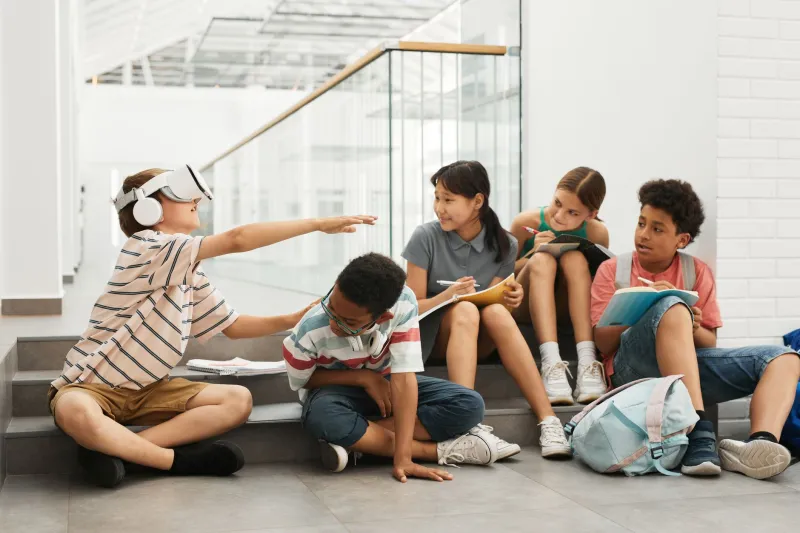
Picture this: a seventh grader in suburban Ohio slips on a VR headset and suddenly she's standing inside a beating human heart. Chambers pulse around her. Red blood cells rush past like tiny red balloons. The sound design is cinematic. The textures are photorealistic. Her teacher watches from the front of the room, quietly thrilled.
She scores lower on the follow-up quiz than the kid who read a labeled diagram in a textbook.
Welcome to the metaverse classroom paradox — the uncomfortable reality that more immersive doesn't always mean more educational. And it's a conversation that educators, platform designers, and neuroscientists are increasingly having out loud.
Your Brain Has a Budget — and VR Blows Through It Fast
To understand why a jaw-dropping virtual environment can actually undermine learning, you need a quick primer on working memory. Think of it as your brain's short-term scratch pad — the mental workspace where you process new information before it gets filed away for long-term storage. The problem? That scratch pad is tiny.
Cognitive load theory, developed by educational psychologist John Sweller in the late 1980s, describes how the brain manages this limited resource. When too many things compete for attention simultaneously, the system gets overwhelmed. Learning slows. Retention drops. Students might look engaged — they're literally inside the lesson — but their brains are spending most of their processing power just navigating the environment.
"What we're seeing in some high-fidelity VR environments is a kind of cognitive traffic jam," explains Dr. Priya Nambiar, a cognitive neuroscientist at the University of Michigan who studies immersive learning technologies. "The brain is allocating enormous resources to sensory processing — spatial orientation, visual detail, auditory cues — and there's just not enough bandwidth left for the actual content."
This phenomenon has a name in educational research circles: extraneous cognitive load. And hyper-realistic virtual environments, it turns out, are extremely good at generating it.
The Fidelity Trap
Metaverse education platforms are in an arms race for realism. Higher polygon counts, more accurate physics engines, spatial audio — these features make for stunning demos at EdTech conferences. They also make for compelling marketing. But classroom data is starting to tell a more complicated story.
A pilot program at a public middle school district in Colorado tested three versions of the same history lesson — one delivered in a high-fidelity VR recreation of ancient Rome, one in a simplified, low-detail virtual environment with the same basic structure, and one through a traditional slideshow with images and narration. Students in the simplified VR condition outperformed both other groups on retention assessments administered one week later.
The high-fidelity group, meanwhile, reported the highest enjoyment scores. They loved it. They just didn't remember it as well.
"Enjoyment and learning are not the same thing," says Marcus Webb, an instructional designer who consulted on the Colorado pilot. "We've confused engagement with education for years in ed-tech, and VR just amplifies that confusion to an almost absurd degree."
This doesn't mean high-fidelity VR has no place in education. Far from it. But the research suggests that context matters enormously. Immersive, realistic environments appear most effective when the sensory experience itself is the content — when a student learning about the scale of the solar system benefits from actually feeling that scale, or when a nursing student practicing a procedure needs the tactile and spatial accuracy to build real muscle memory. For abstract concepts, historical analysis, or anything requiring sustained analytical thinking, stripped-down environments often win.
Finding the Sweet Spot
So what does the ideal VR learning environment actually look like? Researchers and educators who've spent time in this space tend to converge on a few principles.
Purposeful detail over comprehensive realism. Rather than recreating an environment in exhaustive detail, effective virtual classrooms direct visual complexity toward the things that matter. If students are learning about photosynthesis, the chloroplast should be vivid and interactive. The rest of the virtual cell can be relatively sparse. This is sometimes called "guided attention design," and it's a technique borrowed from video game level design.
Paced immersion. Dr. Nambiar's lab has been experimenting with what she calls "immersion ramps" — gradually increasing environmental complexity as students become more comfortable navigating the virtual space. Early in a unit, students work in simpler environments. As their familiarity with both the content and the platform grows, fidelity increases. "You're essentially freeing up cognitive resources over time," she says, "so that by the time the environment gets complex, students have enough mental bandwidth to actually absorb what they're seeing."
Built-in reflection pauses. Some of the most effective VR lesson designs include moments where the environment literally fades or simplifies, prompting students to stop, process, and respond to a question before re-entering the experience. It sounds counterintuitive — why interrupt the immersion? — but these breaks appear to significantly improve retention.
What This Means for Educators Right Now
If you're a teacher who's been handed a VR platform and told to make it work, this research might actually be liberating. You don't need to max out every setting. You don't need the most photorealistic environment available. You need the right environment for what you're trying to teach.
That means asking your platform's instructional design team some pointed questions: Can fidelity settings be adjusted? Are there simplified lesson modes? Has the platform been tested against measurable learning outcomes, or just engagement metrics?
It also means being honest with administrators and parents about what VR does best. Virtual reality is genuinely transformative for experiential learning — for putting students in places and situations that would otherwise be impossible. But it's not a magic upgrade for every kind of content, and treating it like one risks wasting both money and instructional time.
The metaverse has enormous potential to reshape education. That potential is best realized not by going bigger and flashier, but by going smarter. Sometimes the most powerful learning environment is also the quietest one.